Awards

Woodlands Awards Winners 2018 Woodlands Awards Winners 2021

Search This Blog

Sunday, 19 June 2016

sawdust and sawn nails

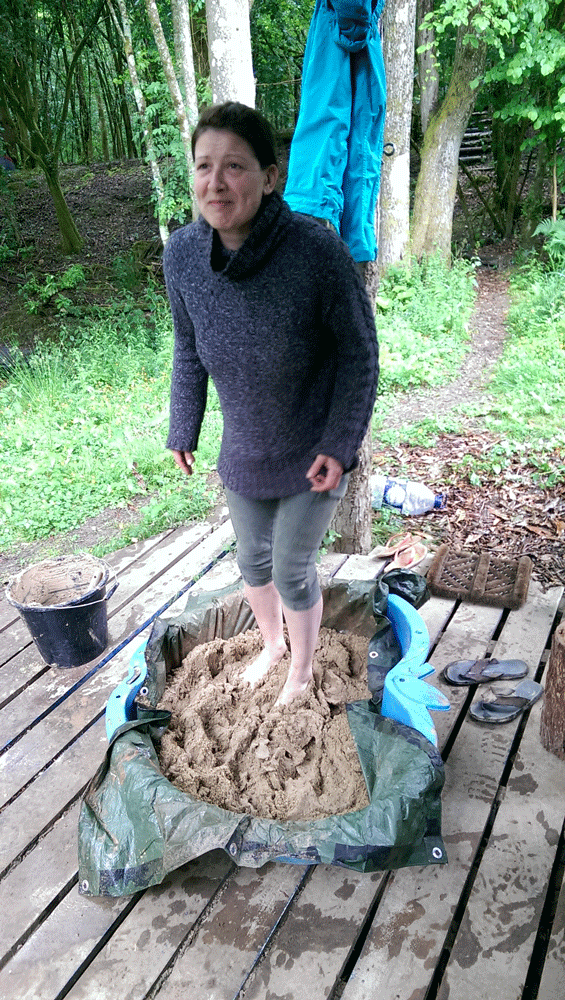
clay and sawdust mix
Finally feel like we broke the back of the prep this weekend. Can almost see the light at the end of the clay tunnel.
With only 41 days to go til our trip to Africa, Tracey and I wanted to get everything ready to lay the second layer next weekend. The all-important insulation layer. With an oven the size of Cassius, we need to be sure he will stay hot for many hours or we will be forever feeding him with logs.
Cassius' entrance drying out
So we spent today mixing up the clay slip and sawdust into batches ready for brick-making. Did quite well, and managed to deplete half a bale of sawdust and 3 trugs of slip. to create enough mix to make 300 or so bricks. Giving ourselves a pretty good head start for next weekend. Cassius has been drying out nicely all the while and with a couple of layers of slip wash is also now void of cracks which is promising.
We have some more filing to do around the chimney/doorway as the smoke level is still a little high, but he's looking in pretty good shape.
We, however, are not! Both Tracey and I have no nails left, aching joints and severely clay-logged skin and clothes.
making trugs of clay slip


Saturday, 18 June 2016

Sausage count hits double figures...

Still a long way to go, but at least the sausage counter is nearly where it needs to be. We think we need 16 eventually and we now have 13 thanks to Tracey's endless puddling.
making a trial batch of insulating bricks
After a trial run at making insulating bricks (clay slip and sawdust), we have a much better idea of the numbers required for the next 10cm layer;
  1. Two jugs of slip to eight jugs of sawdust makes 7 "bricks" 
  2. With the planned width we need approximately 250 bricks to cover it once (5cms deep)
  3. Then to cover again will take another 280 bricks as by then it will be almost 120cms wide!
  4. One trug of slip we now know makes roughly 12 mixes (84 bricks)
  5. So we need five and a half trugs of slip to make a decent insulating layer.
It might not be such great news for our hands, but it certainly makes me feel a lot more comfortable with the amount of clay we will have available. Such a thick insulating layer also means we only need a single outer layer of clay (290 bricks).
Since we plan on starting with 13 sausages, we need to get at least 35 bricks out of each sausage. Sounds reasonable. Any spare can then be used for repairing cracks and moulding the oven into the work surface and rest of the kitchen.

Of course whilst Cassius is coming to life, so is the rest of Rais, and more worryingly... the bracken - it's rampant. The areas we pulled last year have thankfully only come back at probably 50% the volume they were before, so it's important we keep on top of it, else all that hard work will have been for nothing. Simon kindly spent the best part of a day hand-pulling throughout the way-leave to get rid of it before it sets spores and we are back to square one. A back-breaking job, but very rewarding, as large areas can be covered relatively quickly.

Sunday, 12 June 2016

I did another one just for you Tracey!


Weekend 3 : Weary and worried

Cassius has been drying out all week, aided by small fires every night in the form of disposable BBQs. Easy to get going and easy to pull in and out when it looks like the fire is being starved of oxygen.
The drier Cassius got, the easier it was to keep the fire going. At times it was too hot to hold a hand on the top of the clay and so we know it will work well as an oven once it's all done. Worryingly though, there was smoke also escaping from cracks all the way round as the last lower 6 inches dried out. We have since filled them with fire cement and also raised the opening an inch or so to meet the level of the smoke ceiling in the oven. We don't want to start on the next layer (the flammable layer!) until we are 100% certain no more cracks will form and the existing crack repairs are solid.
This expected setback didn't stop us of course and we spent the weekend building the entrance way and continuing with the sausage-making in preparation for the third layer when we get there.
We are on schedule at the minute with 7 sausages ready, 7 buckets waiting to be puddled and a trug full of slip, We still need 2 more buckets of clay, 9 sausages and another trug of slip but the end of the prep is in sight and it should get easier from here on in.... although having said that we have done some calculations to work out roughly how many bricks we need for each of the next stages and it's going to take a while! We think 200 bricks of insulating material and 550 bricks for the final clay layer. We don't yet know how many bricks per sausage so it's all still a bit of a guess... but the oven is currently 106cms in diameter, if all goes to plan with the rest of the build, Cassius will be 140cms wide when finished, which is quite large!
The brick entrance arch/tunnel wasn't quite as easy as I thought it would be, but thankfully I was alone during the build and so no-one had to suffer my foul-mouthed-headless-chicken impression. It took about an hour, an entire sausage, a terracotta flower pot and half a bag of sand (as well as the log template of course) to complete. The sheer size of it has actually made the oven dome itself look tiny all of sudden, but I know it will swing back the other way when the final layers are on. Now starts the drying out process yet again and with fingers crossed I am off to Wales for a couple of days, so we shall see how successful it's been when I get back and remove the log template currently holding it up.


Tuesday, 7 June 2016

How to tackle the woodland flying, biting insects

Darter
I suffer horrendously with insect bites, always have done, so before any trip to the jungle, I typically spend some time reading up on the latest mosquito research to see if anything new has come to light which might help me. Given that more than a million people are killed from mosquito bites every year, there's usually quite a lot of new stuff to read.
Last year I watched an experiment on the internet that involved a number of volunteers and some sweaty socks - the experiment proved that certain people are massively more attractive to mosquitoes than others and that it was something to do with the pheromones they give off when they sweat. A chemical spray is in trial at the moment to disguise or neutralise these pheromones making people "invisible" to biting insects. But it's a long way from hitting our high streets.  This year I've learnt that it's not just pheromones, but that they feed on the bacteria that is present on your skin and in your sweat. Over time, bacteria multiplies of course which is why mossies are particularly fond of stale sweat; the stuff that bacteria has had a chance to work on. Guess I'm going to need to change the socks more often at the wood!

my first Dragonfly in flight! very frustrating shoot
I've also learnt that it's best to avoid bananas, because something about how they are metabolised seems to attract mosquitoes too.

My itchy, frustrated side wants to squash every mosquito on sight, but my Druidic side is keen to encourage natural predators at the wood to get the problem under control. This means installing plenty of bat boxes and ensuring dragonflies (who consume almost as many mossies, midges and gnats as bats do) have a perfect place to live. This is of course under way with the construction of the dam to create a sunny pond, but if I was a dragonfly, what would I be looking for as the perfect environment to breed? Apparently the list looks a bit like this;
  1. Pond in full sun no less than 2 feet deep
  2. Rotting logs at the edge of the water to lay their eggs in
  3. Marginal plants for the larvae to crawl up when they emerge from the water
  4. Some large rocks in full sun for them to bask on and dry out their new wings
A mosquito doing what it does best on a person's arm
I don't think that's too much to ask and I think the pond we have in mind will easily meet these requirements.  It seems crazy to put in water when we know that's what attracts mossies, but I would rather they were over by the pond instead of piercing my skin at the Yardarm.
In terms of plant life there don't appear to be too many that are native to this country that would help around the Yardarm. But given that a child dies from malaria every 30 seconds, there will thankfully always be more research going on.
Click here if you'd like to give a mosquito net to the people of Zambia.